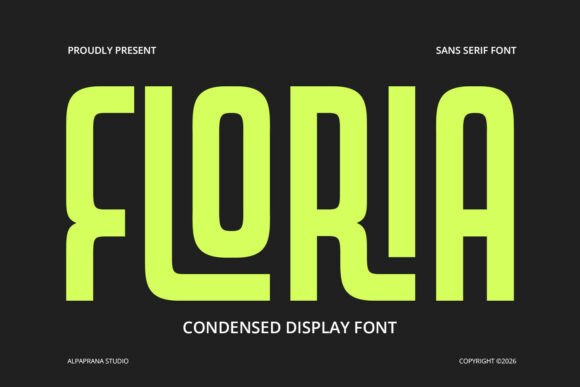
Floria: A Modern Display Font for Bold Branding
Every brand has a voice, but not every brand knows how to make that voice visually distinct. You can spend weeks perfecting your color palette, refining your mission statement, and curating your photography, yet if your typography falls flat, your message loses its punch. This is where the weight of a typeface comes into play. It isn't just about legibility; it is about personality. When you are designing for a modern audience—one that scrolls quickly and judges instantly—you need a typeface that commands attention without screaming for it. You need something that feels current, polished, and versatile enough to handle the chaotic mix of digital and print media we navigate today.
Capturing the Modern Aesthetic
The Floria typeface steps into this space as a display font designed with a distinctly modern sensibility. If you look at current design trends, you will notice a shift away from the overly ornate and the strictly utilitarian. Instead, we are seeing a blend of clean geometry with subtle personality. Floria fits perfectly into this niche. It carries the weight and presence necessary for a display font—meaning it looks fantastic at large sizes on posters, headers, and signage—but it avoids the cold, sterile feeling that some modern fonts suffer from. It has a rhythm to it. Whether you are working on a fashion lookbook, a magazine spread, or a high-impact poster, this font brings a level of sophistication that suggests you know exactly what you are doing.
What makes a display font "work" is its ability to hold the viewer's gaze. In branding, particularly for lifestyle, fashion, or editorial projects, the typography often acts as the visual hook. Think about a shopping bag carried down a busy street or the cover of a book sitting on a crowded shelf. The letterforms need to be distinct enough to be recognizable from a distance but detailed enough to reward a closer look. Floria achieves this balance through its construction. It is not just a set of letters; it is a design asset that adds texture and tone to your layout.
Practical Versatility Across Media
One of the biggest headaches in design work is finding a typeface that translates well across different mediums. You might find a font that looks incredible on a t-shirt mockup but turns into an unreadable mess when used for a sub-headline on a website. The versatility of the Floria font is one of its strongest selling points. Because it includes both uppercase and lowercase letters, numerals, and standard punctuation, you aren't limited to using it for just one specific task.
Consider the scope of a typical brand launch. You might be designing a logo (the cornerstone of the identity), followed by social media graphics for Instagram and Pinterest, email headers, and perhaps some physical merchandise like tote bags or stickers. A premium font like Floria allows you to maintain visual consistency across all these touchpoints. You aren't scrambling to find a "matching" font for your subtext because the family is designed to work within its own ecosystem. The availability of Web Open Font Format (WOFF) files alongside the desktop versions (OTF and TTF) means you can seamlessly move from your design software in Adobe Illustrator or Photoshop directly into your web development environment without losing quality.
For those in the packaging design space, specifically for cosmetics, artisanal goods, or boutique clothing, typography is often the primary differentiator. You might have a simple label, but if the typeface has character, the product looks premium. Floria’s stylistic sets and ligatures offer a layer of customization that is often reserved for much more expensive typefaces. These features allow you to swap out specific letter combinations to create a more fluid, custom look, preventing that "digital" feel that can sometimes make a design look generic.
Strategic Pairing and Readability
While a display font is great for grabbing attention, it is rarely a good idea to use it for long paragraphs of body copy. This is a common mistake among new designers and entrepreneurs. A font with high personality, like Floria, is best used for headlines, sub-headlines, and callouts. For the body text—those longer descriptions on your "About" page or the details on your packaging—you need something that prioritizes readability over flair.
A practical approach to font pairing is contrast. If you are using a modern display typeface like Floria for your headers, consider pairing it with a clean sans-serif or a simple serif font for the body text. You want the two to complement each other, not compete. For example, if Floria is being used for a bold poster headline, a neutral sans-serif like Open Sans or Lato can provide the breathing room the viewer needs to process the information. The goal is to create a hierarchy. The viewer should immediately know where to look first (Floria), and then naturally flow into the supporting text.
Another aspect to consider is the context of the medium. On digital platforms, screens can vary in resolution, and small, complex details can get lost. Floria’s clean lines and modern construction ensure that it renders well on high-definition screens, but for mobile viewing, keeping it to header sizes is a safe bet. For print applications—like business cards or magazine covers—the higher resolution allows the subtle nuances of the typeface to shine through, giving your physical assets that tactile, professional quality.
Global Reach and Technical Reliability
In our increasingly connected world, your audience might not always speak English. If you are a small business owner expanding into European markets or a content creator collaborating with international artists, you need typography that supports multiple languages. A significant technical advantage of the Floria font is its support for multilingual characters and accents. This isn't just a "nice to have"; it is a functional necessity for maintaining brand integrity across borders. You shouldn't have to switch to a different, mismatched font just because you need to type an accent mark. This feature ensures that your visual identity remains consistent whether you are writing in English, French, German, Spanish, or other Latin-based languages.
Furthermore, the technical installation and compatibility of a font file can sometimes be a stumbling block. The fact that Floria is provided in OTF, TTF, and WOFF formats covers all the bases. It works seamlessly on both PC and Mac, which is essential for teams that might be using different operating systems. Simple installation means less time troubleshooting technical issues and more time actually designing. For a busy entrepreneur or a freelancer juggling multiple clients, this reliability is worth its weight in gold.
Elevating the Everyday Project
Ultimately, the tools we choose for our creative projects dictate the final output. We often look for "premium" assets because we want our work to look professional, not homemade. However, "premium" doesn't have to mean inaccessible or overly complex. The value of a typeface like Floria lies in its ability to elevate the everyday project. It takes a standard business card and makes it memorable. It takes a simple social media quote graphic and makes it shareable.
If you are working on a special event—perhaps a wedding invitation suite or a gala program—the elegance of the font adds a layer of ceremony and importance. If you are designing a logo for a new tech startup or a creative agency, the modern feel of the typeface communicates innovation and forward-thinking. It is a versatile tool in your design arsenal. By incorporating a display font that balances aesthetic appeal with technical robustness, you are setting your project up for success. It ensures that your visual communication is not only seen but felt, creating a lasting impression that aligns with your creative vision.